
When Does a Business Actually Need Contract Lifecycle Management?
Start with clear agreements, then decide how much help you need to manage them
When contracts feel disorganized, it's worth checking the agreements and the process before buying software. Unclear terms, missed renewal dates, and uncertainty about the current version are different problems. Software may help with tracking, but it won't make unclear terms appropriate for the work.
Start by separating the terms of the agreement from the work of tracking and fulfilling it. Buying a tool before understanding which part is failing can leave the original problem unresolved.
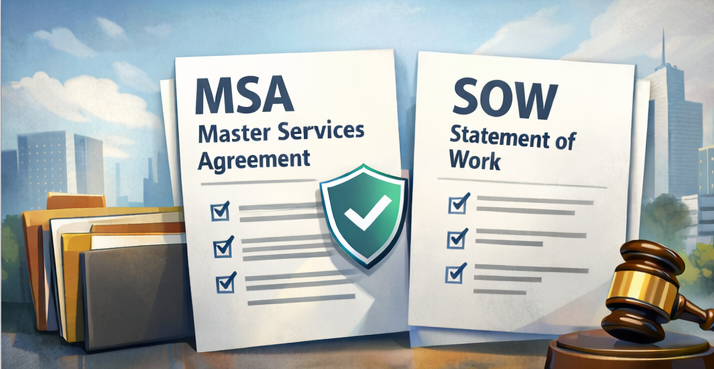
Two Documents That Define the Relationship and the Work
Custom services such as websites, consulting, creative work, or construction involve commitments about deliverables, price, and conditions. Misunderstanding those commitments can create problems between agreeing to the work and receiving payment.
One common approach is to separate the terms of the ongoing relationship from the scope of each project. An MSA and SOW can do that, though some businesses use a combined agreement or another structure suited to their work.
A Master Services Agreement (or MSA) sets agreed terms for a client relationship. It can address payment, ownership, liability, confidentiality, and ending the relationship. Later projects may use those terms, subject to the agreement's scope and any changes the parties make.
A Statement of Work (or SOW) describes a particular project: deliverables, timing, price, scope exclusions, assumptions, and responsibilities when inputs or conditions aren't met. Those details help both parties understand the work before it begins.
These documents can make responsibilities and scope clearer; their names alone don't guarantee protection. What matters is what the parties agree to, how the terms fit the work, and the law that applies. This explanation of how MSAs and SOWs work together is a useful starting point. Have the terms reviewed for your situation when the commitments or risks warrant it.
Three Ways This Can Go Wrong
Someone claims they own work you created
Imagine completing a website project and being paid, then finding six months later that a new designer is reusing its layout approach, code, or structure.
You may believe the client received rights to the final product but not your general methods, while the client believes payment transferred everything.
If neither understanding was recorded, the disagreement becomes harder to resolve. Clear terms give the parties a reference for what was actually agreed rather than relying on different recollections.
Clear ownership terms in the MSA can reduce this ambiguity and give both parties a written reference if a dispute arises.
A contract renews automatically and nobody noticed
Imagine a year-long agreement that renews for another year unless notice is given 60 days in advance. If nobody tracks the deadline, month 11 and month 12 can pass without anyone acting.
Two weeks later, the client's budget may change and they ask to stop or reduce the work, while the agreement provides for another year.
That can leave a difficult choice between enforcing the commitment and accepting lost expected revenue, potentially straining the relationship for the next twelve months. The avoidable operational gap is that no one tracked the renewal decision in time.
A calendar date, reminder, and clear owner may address that tracking problem without requiring contract management software.
"Integration" means completely different things to you and the client
"CRM integration" can hide a similar disagreement about scope. You may mean connecting a website contact form so leads enter a customer relationship management (CRM) system automatically.
The client may expect workflows, lead scoring, email sequences, and ongoing synchronization across systems. Three weeks into the project, you could discover that the same phrase represented different work to each party.
Renegotiating then is difficult because each person believes the original agreement described their expectation.
Define the intended behavior, assumptions, and exclusions before work starts. Specific scope gives both parties a way to assess changes instead of debating the meaning of a broad label.

What You Need at Different Stages
Suitable documents and a maintainable process are useful before the volume of contracts warrants specialized software.
Just starting out with straightforward projects
You still need clear written terms and a way to keep track of the agreed version, scope, payment obligations, and important dates. A document folder and calendar may be enough when the workload is manageable. A small client count doesn't remove the need for sound agreements.
Growing and getting repeat clients
This is where things change. You're working with the same clients multiple times, doing ongoing work, pricing things differently for different situations. This may be a reason to standardize reusable terms and project scopes, including through MSAs and SOWs where they fit. The need comes from repeated work and coordination, not a particular business size.
Focus on reusable terms that actually fit the work, with scope and exclusions clear enough to discuss. Standardization is useful when it reduces repeated uncertainty rather than conceals differences between projects.
Managing many active contracts or complex obligations
Volume or complexity may make manual tracking difficult. You have multiple projects per client, change requests, different renewal dates, varying terms across accounts.
Tracking becomes another responsibility alongside drafting suitable terms. The business needs a reliable way to identify the current version, the commitments it contains, and the next renewal or decision date.
Contracts are feeding other business systems
This is when contract lifecycle management (CLM) software starts making sense: tools that help manage agreements from creation through their ongoing use. Examples include Ironclad, DocuSign CLM, and Agiloft.
At that point, agreements can supply information for routing work, tracking renewals, searching prior commitments, and coordinating risk across the business. The software's value comes from supporting those activities rather than marking a stage of company maturity.
Compare the tracking problem with the proposed solution
Begin with suitable agreements and a process someone can maintain, then assess which responsibilities exceed that process.
A construction business with 40 people might face more tracking complexity than a software company with 200, depending on contract volume, variation, and renewal timing. Organization size alone doesn't describe the workload.
Those counts are illustrations, not thresholds. A few complex or high-risk agreements may require more attention than many simple ones, so assess the actual commitments before choosing software.
For more detail on structuring the documents, these references provide starting points:
- A practical breakdown of how MSAs and SOWs work together
- A detailed look at what goes into an MSA (liability, IP, payment terms)
- A step-by-step guide for writing clear SOWs that avoid scope creep
Use those references to inform the work rather than assume a template fits every relationship. The terms and the process both need to suit your situation.
Related Articles
When the Systems Working for You Start Working Against You
The tools that create leverage can also create constraints. The challenge is knowing when to keep, extend, simplify, replace, or build.
Read more →Making Business Rules Visible With Example Mapping
How concrete examples helped turn complex global pricing rules, exceptions, and operational knowledge into shared understanding before they became software.
Read more →Automate the Outcome, Not Just the Task
A practical way to think about workflow automation, AI agents, total cost of ownership, and how much autonomy a business process actually needs.
Read more →