
AI Search and Organic Traffic: What Small Businesses Should Examine
Understanding the behavioral shift and how to refine your digital strategy without starting over.
When visits from unpaid search results, or organic traffic, stop growing, it's easy to question the familiar advice about ranking, keywords, and regular blog posts. Before changing the strategy, I want to understand which visits are changing and whether inquiries or sales are changing with them.
A traffic plateau doesn't establish its cause. Search behavior may be part of the explanation, alongside other changes in the business and how its audience finds information.
Google Search includes AI-generated answers, and people can also use conversational tools for product research and service comparisons. These experiences give customers additional ways to explore a question; they don't replace every search or website visit.
Someone might search "best website designer near me" or ask a conversational tool "who should I hire if I need online booking and SEO?" The latter gives more context about what the customer needs. Content that addresses that fuller decision can be useful without assuming every customer has adopted the same search behavior.
Answers Without a Website Visit
Some questions can be answered within a search result or AI conversation. Other answers prompt people to follow links and investigate further. The effect on your site depends on the question, the experience, and what the customer needs next.
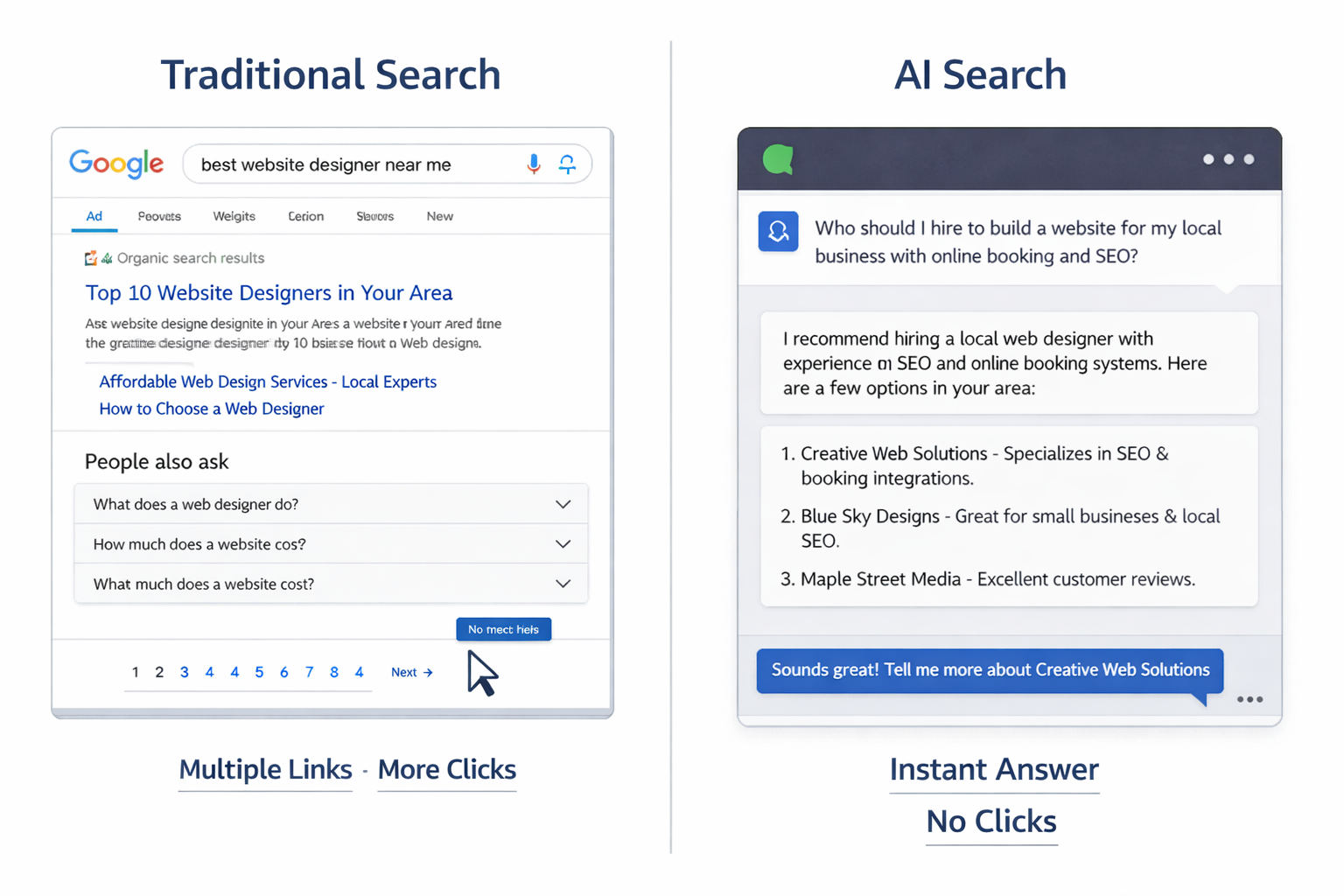
If informational visits are falling, look at which pages and queries changed before attributing the decline to AI. Compare inquiries and sales as well as visits. A page that receives fewer casual clicks may still bring in useful customers, while stable traffic can conceal a problem with conversion.
Give people something useful beyond a summary
AI tools can combine information into a summary, which may answer some questions without a visit to your site. That makes it useful to examine what a reader would learn from your business that a generic explanation doesn't provide.
Specific positioning, case studies, evidence, and experience can help someone assess whether you're a fit. The opportunity is to make those details useful and understandable, rather than adding volume to information already widely available.
Examine the change before overhauling the strategy
A drop in traffic can make a full overhaul feel urgent, but committing time and money before understanding the change can replace work that still helps customers.
Start with a problem visible in your results or customer conversations. That gives the change a purpose and provides something to compare afterward.
What's Still Worth Doing
Keep useful SEO work in place. Check that people can find accurate service information, navigate your site, and take the next step. Google says its established SEO practices also apply to AI Overviews and AI Mode; it doesn't require a separate set of special optimizations. That guidance concerns Google, not every AI service.
Build topical authority instead of scattered blog posts. Focus your content on your services and the specific problems customers ask about. That makes it easier to choose topics where you have something useful to contribute and to maintain the information over time. A focused site makes your expertise easier to assess. Treat that as a reason to organize your content well, rather than a guarantee of appearing in an AI-generated answer.
Make the business identifiable and credible. Accurate reviews, clear service and About pages, a maintained Google Business Profile, and a sound technical structure help people and search tools understand who you are. They need to work together; no single profile or page establishes credibility on its own.
What's Worth Starting Now
Write for humans first, AI second. Choose a format that helps the reader make a decision. A comparison may help someone weigh options; an FAQ may answer questions that keep coming up. Use those formats for their usefulness, not as a promise of search performance.
Check whether your site explains the business clearly. A person or automated system needs enough information to understand who you help and how. An AI tool's summary may expose a gap, but one response isn't a reliable measure of how every customer discovers the business. Improve unclear information because it helps readers assess the service.
Diversify your traffic sources. Depending on one source leaves you exposed when it changes. Email, referrals, partnerships, or another relevant channel may help spread that dependence, but each takes time to maintain. Test an option your audience uses and your team can realistically support.
What's Not Worth Doing
Don't abandon useful work without checking it. Before cutting a channel or rebuilding the site, look at the inquiries and customers it still brings in. Keep what serves your audience and test changes where the evidence points to a problem.
Don't publish more content simply because AI makes it easy. Each article needs a useful purpose, accurate information, and someone responsible for keeping it current. A smaller collection you can support may serve your readers better than a large collection of repetitive answers.
Make the next step easier. Slow loading, poor mobile readability, or an unclear call to action can frustrate visitors you've already reached. Examine where they struggle to inquire or buy alongside the work of bringing them to the site.
Let customer behavior guide the next decision
Search and AI tools may both influence how your customers learn and choose. Your results and customer feedback give you a better basis for deciding where to spend effort than a general prediction about the future of traffic.
Unclear services, weak evidence, and a difficult next step are gaps you can investigate and improve without starting over. Check whether those changes help the people you're trying to reach.
Related Articles
Automate the Outcome, Not Just the Task
A practical way to think about workflow automation, AI agents, total cost of ownership, and how much autonomy a business process actually needs.
Read more →What’s Your Setup?
AI-assisted development gives one person more leverage than ever. The harder question is how to manage the responsibility, attention, and context that come with it.
Read more →AI Might Change the Software. It Won’t Remove the Problem.
AI is changing the economics and boundaries of software, but the organizational problems underneath it still need to be understood and solved.
Read more →