
How Email Marketing Actually Works: The Ecosystem Behind Deliverability
A behind-the-scenes look at IP reputation, mailbox providers, and the infrastructure that determines inbox placement

An email campaign can have a thoughtful subject line, useful content, and a clear design without reaching the person it was written for. To understand that gap, it helps to look at the sending infrastructure and the decisions made by the systems receiving the message.
It All Starts with Your Email Service Provider
An email service provider (ESP), such as Mailchimp or Klaviyo, supports more than designing a campaign. Sending at scale also depends on servers, authentication, monitoring, and the provider's management of the traffic moving through them.
Authentication checks such as SPF and DKIM help verify the sender, while compliance safeguards and monitoring support the sending system. Those responsibilities sit behind the send button even when the business rarely sees them.
Sending Internet Protocol (IP) addresses identify the servers messages come from. How those addresses are used and managed influences delivery alongside other factors.
Shared vs. Dedicated IPs
A business may send through an IP address shared with other customers or an address dedicated to its own mail. The difference changes how much responsibility it has for maintaining that part of its sending reputation.
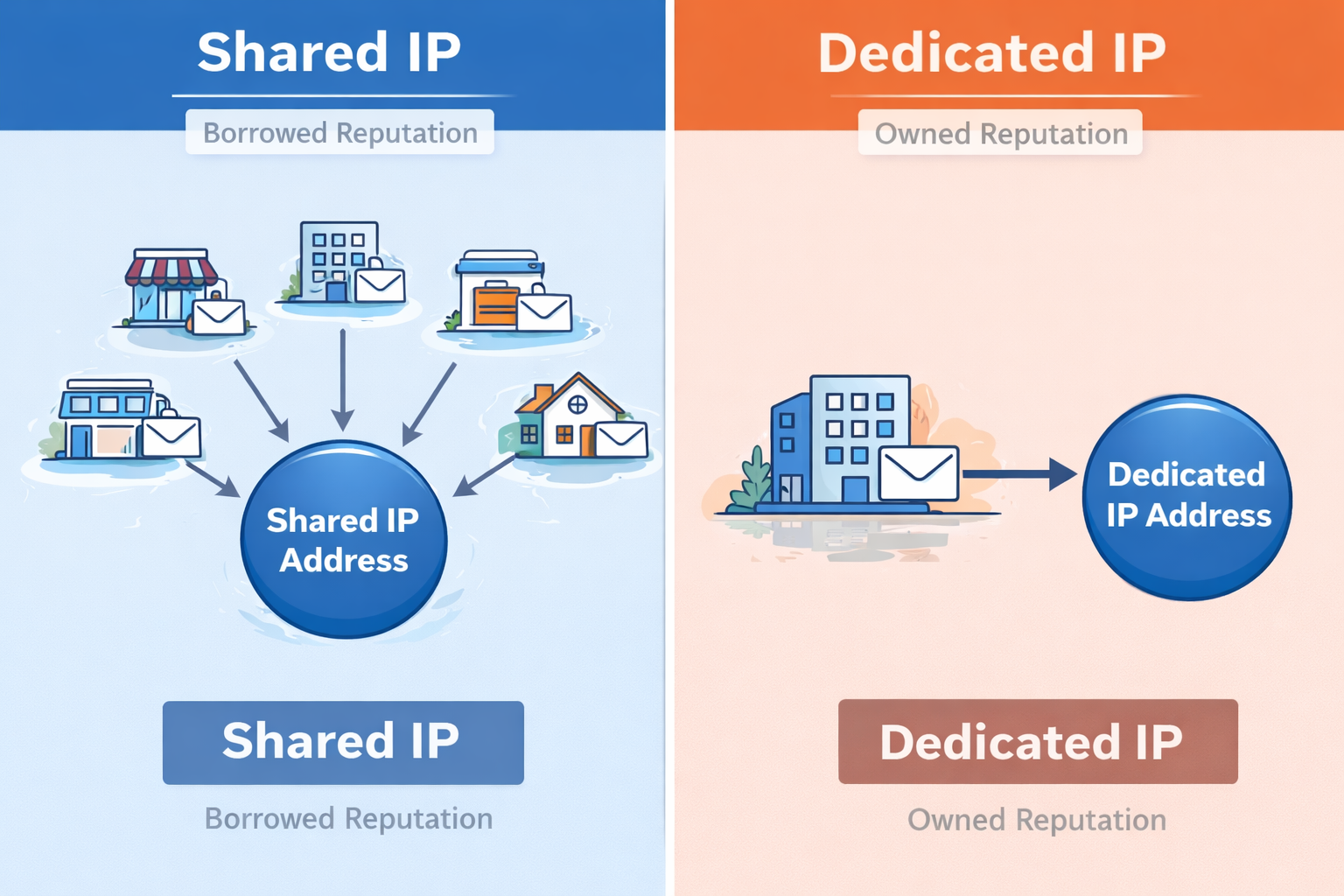
Shared IPs are how most businesses send email. Your messages travel through the same address used by dozens or hundreds of other senders on your ESP. You're borrowing reputation from the group.
ESPs manage these shared IPs carefully. They warm them up gradually, monitor traffic patterns, remove bad actors, and work to keep the overall reputation healthy. For small and mid-sized businesses, that's actually a good thing. You benefit from the ESP's expertise without having to become an expert yourself.
Dedicated IPs are sometimes used by larger senders. Only their mail uses the address, giving them more control over sending behavior but also responsibility for its consequences. Inconsistent sending, poor list quality, or aggressive campaigns can damage that reputation, and recovery takes time.
IP Reputation and Why It Shapes Everything
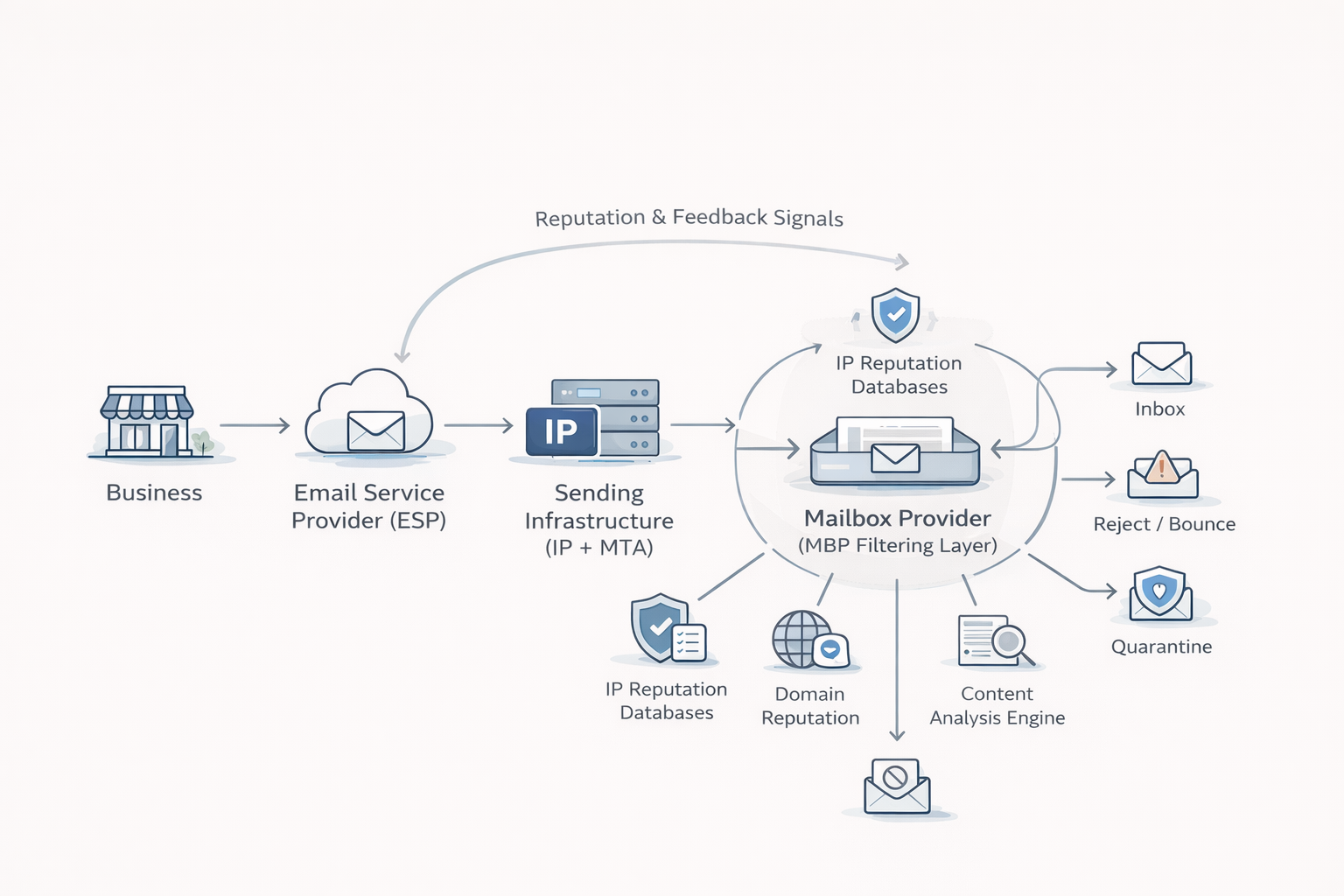
Mailbox providers such as Gmail use automated systems to assess incoming mail at a scale that individual manual review couldn't support.
Sending history, complaints, bounces, engagement, and consistency contribute to reputation assessment. The evaluation helps a mailbox provider decide how to handle a message rather than treating every campaign independently.
A strong reputation supports inbox placement. A declining one can lead to throttling (slower delivery), spam folders, outright rejection, or messages being held in quarantine.
That means delivery is influenced by patterns of behavior over time, not just the content of the email being sent.
The Network Behind Every Email
Delivering a campaign involves more than the sender and ESP. The receiving mailbox provider and reputation systems around the network also affect what happens.
Mailbox providers like Gmail, Yahoo, and Microsoft operate the inboxes your customers actually use. Their job is to filter spam, protect users, and decide where each email lands. To do that at scale, they pull from reputation data across multiple sources.
Reputation and monitoring providers are companies most people have never heard of that track sending behavior across the internet. They maintain blacklists and whitelists, score IP and domain reputation, and share threat intelligence with mailbox providers. If your IP shows up on one of their blacklists, your deliverability can suffer across multiple providers at once.
Information about sending behavior can influence more than one provider, so a problem may have consequences beyond the place it's first noticed.
Why ESPs Protect Their IP Infrastructure So Carefully
Shared addresses create a dependency between senders: problematic traffic from one customer can affect others using the same infrastructure. ESPs therefore have an incentive to manage who uses it and how.
So instead, ESPs build large IP pools, lease additional infrastructure, segment senders by quality, and rotate and warm IPs strategically. They also remove problematic senders to protect the shared reputation everyone else depends on.
That helps explain the enforcement of compliance policies. Protecting shared reputation supports other customers' ability to deliver mail, even when a restriction frustrates an individual sender.
When Reputation Slips
When reputation declines, a mailbox provider may slow delivery, send mail to spam, reject it, or quarantine it. Understanding the response helps the business investigate rather than assume the campaign reached every recipient.
The assessment extends beyond IP reputation to the sending domain, authentication alignment, and recipient engagement. Deliverability depends on those parts working together, so changing one doesn't necessarily resolve the full problem.
The Tension Inside Shared Infrastructure
Because IP reputation is shared, ESPs have to protect the health of the network. One sender abusing the system hurts everyone else on the same IP.
To prevent that, ESPs enforce permission policies, suppress risky contacts automatically, maintain internal block lists, and restrict or terminate accounts that create risk.
If you upload a contact list that wasn't clearly permission-based, the ESP may suppress those addresses permanently. In some cases, contacts flagged as risky can't be emailed again within that ecosystem, even if you later get proper permission.
Those restrictions protect the network while also giving providers authority over which contacts can be reached through it. The tradeoff looks different to an ESP managing shared risk than to a business trying to use its existing data.
When Incentives Don't Line Up
An ESP wants healthy sending reputation and relationships with mailbox providers, while a business may want to reach more people, recover old leads, and use existing contact data. Those goals can conflict.
Within shared infrastructure, an individual sender doesn't fully control the reputation it depends on. Understanding that constraint helps explain why a provider's decision may not match the business's immediate preference.
What Small Businesses Actually Need to Know
Pressing send doesn't guarantee arrival. Sending to cold or purchased lists, ignoring engagement, and failing to manage inactive subscribers can affect more than one campaign because behavior feeds back into the reputation of the system.
For a provider managing shared infrastructure, enforcing permission and list-quality requirements is part of maintaining delivery for the businesses using it.
Work on the parts your business can manage
Email performance depends on messaging and the infrastructure carrying it. ESPs manage sending systems, reputation providers monitor behavior, mailbox providers assess incoming mail, and businesses contribute through their contact and sending practices.
Seeing those relationships makes permission, list quality, authentication, and consistency part of the marketing decision rather than separate technical concerns.
Start with those factors your business can manage, and examine the provider's reports and policies when delivery changes. A stronger understanding of the system helps you investigate without assuming a subject line or design change will solve an infrastructure problem.
Related Articles
Marketing Attribution, Fading Influence, and the Delay Before a Sale
How to assess earlier marketing work when the sale comes later
Read more →Is Email Marketing Worth It for Small Businesses?
A practical system for staying in touch and encouraging customers to return
Read more →AI Didn’t Change the Rules. It Made Weaknesses Visible.
Help customers understand your services and assess whether you're a fit
Read more →