
Marketing Attribution, Fading Influence, and the Delay Before a Sale
How to assess earlier marketing work when the sale comes later
A marketing report may credit a sale to the last ad or search a customer clicked, even when earlier contact helped create their interest. That can make it hard to decide which channels deserve your budget.
Attribution assigns credit for a sale to marketing interactions, with first-click and last-click models assigning that credit differently. The allocation helps organize a report, but it doesn't establish what caused someone to buy.
I started paying closer attention to that distinction while building digital marketing tools and seeing how reports influenced budget decisions.
I find it useful to separate three ideas. A time-decay attribution model gives more credit to interactions closer to a purchase. Fading influence describes the possibility that a message's effect decreases over time, while purchase delay is the time between an interaction and buying. The model represents an assumption about timing without proving either behavior.
Adobe's attribution documentation explains time-decay weighting. Available models vary by platform; Google Analytics no longer offers its former time-decay model. The practical question here is broader: how do you judge earlier marketing work when the sale comes later?
A Simple Real-World Example
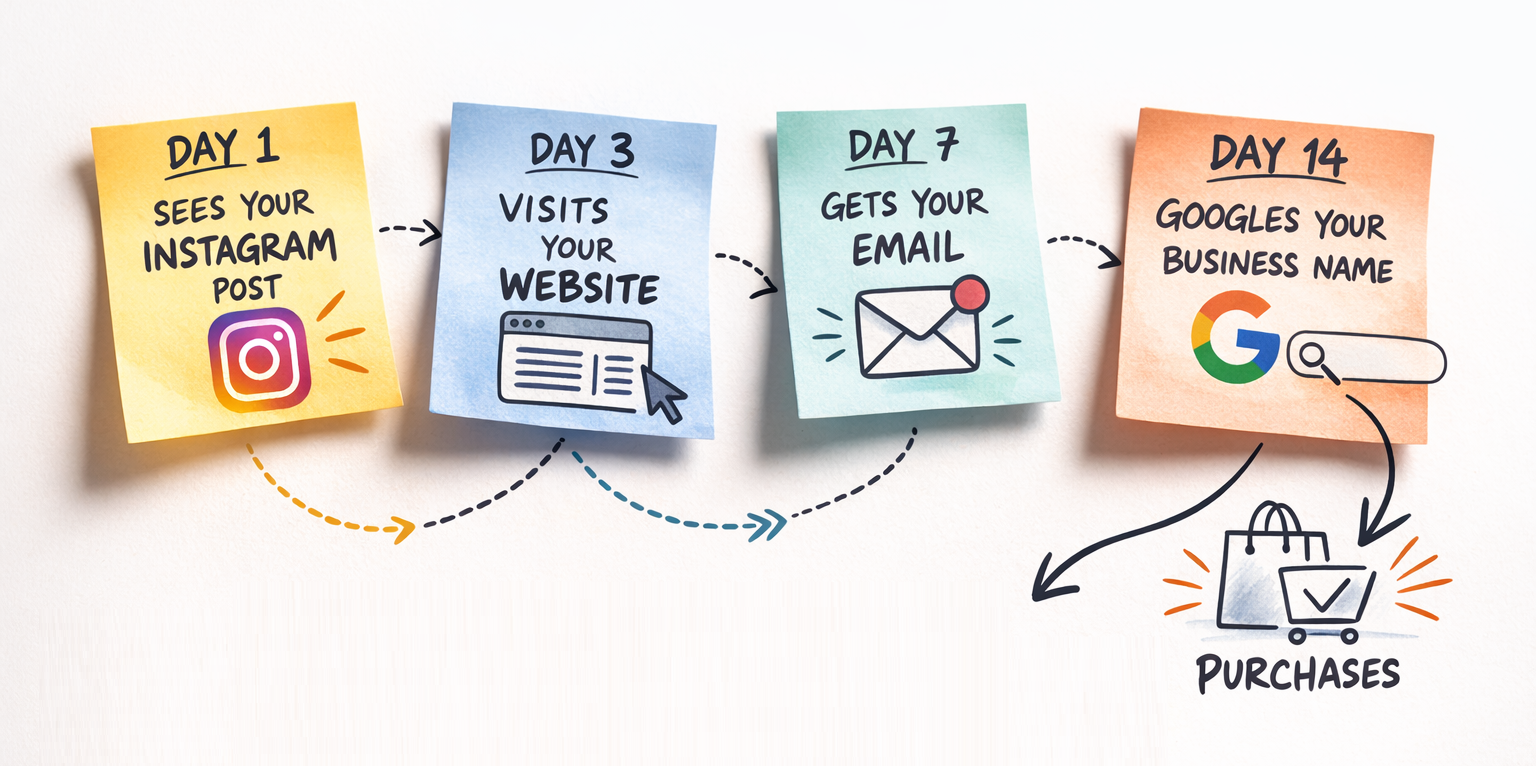
Imagine this timeline for a potential customer:
- Day 1: They see your Instagram post
- Day 3: They visit your website
- Day 7: They get an email from you
- Day 14: They Google your business name, then they buy
In a simplified last-click report, the final tracked search might receive all the credit. A different model could distribute it across several interactions. Neither allocation tells you, by itself, whether the customer would have bought without the earlier post or email. Check the model and tracking settings behind your own report rather than assuming every platform uses the same default.
The timeline gives you a hypothesis to examine: the post may have introduced the business, the email may have reminded the customer, and the search may have made the purchase easier. Those roles can overlap. The report records a path, but understanding the contribution of each step takes more evidence.
Compare reported credit with the channel's role
Retargeting, or showing ads to people who've already interacted with a business, can look profitable because it reaches people who may already be interested. Some of that interest may have developed through another channel.
That doesn't make retargeting unhelpful or establish that every awareness campaign should keep its budget. It gives us a reason to examine each channel's intended role and the evidence for continuing to fund it, alongside the credit assigned by the report.
The lag between a change and its effects
If you reduce a channel that introduces new customers, any effect on sales may take time to appear. The delay depends on how people buy, how frequently they encounter your business, and the role that channel actually plays.
A later sales decline is a reason to investigate, not proof that the cut caused it. Seasonality, pricing, competition, tracking changes, and other marketing activity may also explain what happened. Look for evidence that separates those possibilities.
Why timing matters as you grow
As spending grows, a mistaken assumption becomes more costly. If customers take time to decide, judging a campaign only by immediate purchases may miss some of its contribution; if they buy quickly, waiting months to assess weak performance may waste money.
The evaluation period should reflect that buying process and the evidence available, rather than a universal rule about how long marketing needs to work.
Use the data to examine a decision
A useful starting point doesn't need a complicated dashboard. It needs a clear connection between what you're measuring, what you expect a channel to do, and the spending decision you're considering.
Watch Both Early and Late Signals
Track activity along the buying process: relevant reach, visits, inquiries, purchases, and return business. Some measures may change before sales do, but their role depends on the process. A branded search could be an early research step or the final step before buying.
If early signals drop, watch whether later sales measures also weaken. That pattern may warrant investigation, but it doesn't establish the cause. Reach and engagement are useful only when you can connect them to the customers and outcomes you care about.
Check how you're reaching new customers
If 100% of the budget goes to people who already know you, strong reported returns may conceal a gap in bringing new people into the process. Consider how the current spending supports discovery, continued contact, and the decision to buy.
Before shifting more money into retargeting, ask whether you're still reaching enough new potential customers and whether that reach is producing useful inquiries. The right balance depends on the business, not a fixed split between channels.
Look at Longer Trends
Daily results can be noisy, especially with few purchases. Look at a period long enough to include the usual buying cycle and enough activity to make a comparison useful. Compare similar periods and note other changes that could affect the results.
Test Cuts Slowly
If you can afford to test a change, reduce spending by a bounded amount and decide beforehand what you'll measure and when to review it. Set the size and duration around your budget, sales cycle, and data, then examine inquiries and purchases alongside branded searches and retargeting. A decline is a reason to investigate the channel's influence, not proof that the cut caused it.
Check the explanation behind the report
Before cutting or expanding a channel, check how the report assigns credit, how long customers take to buy, and what evidence suggests the channel brings business you'd otherwise miss.
You may still choose to cut it. You'll be making that decision with a clearer understanding of what the numbers can and can't tell you.
Related Articles
How Email Marketing Actually Works: The Ecosystem Behind Deliverability
A behind-the-scenes look at IP reputation, mailbox providers, and the infrastructure that determines inbox placement
Read more →Where Is Value Actually Created in a Business?
Customers experience the entire chain of interactions — not just the product.
Read more →When "How Do I Get Paid?" Stops Being a Side Question
Choosing payment infrastructure is really about deciding how much complexity you want to own
Read more →