
When "How Do I Get Paid?" Stops Being a Side Question
Choosing payment infrastructure is really about deciding how much complexity you want to own

Payments can feel like a later question while you're building something, until a customer asks what it costs and how to buy. At that point, you need a checkout that works and an arrangement for the money to reach the business.
For software sold online, the arrangement also determines who sells to the customer, who handles transaction taxes, and who maintains billing. Comparing those responsibilities is more useful than choosing a payment button by brand, particularly when one provider offers several operating models.
Choose the Responsibilities Before the Brand
Before comparing checkout tools, decide how much billing and tax administration your business can realistically handle. A processor and a merchant-of-record service divide the work differently, so check the specific arrangement rather than infer it from the provider's name.
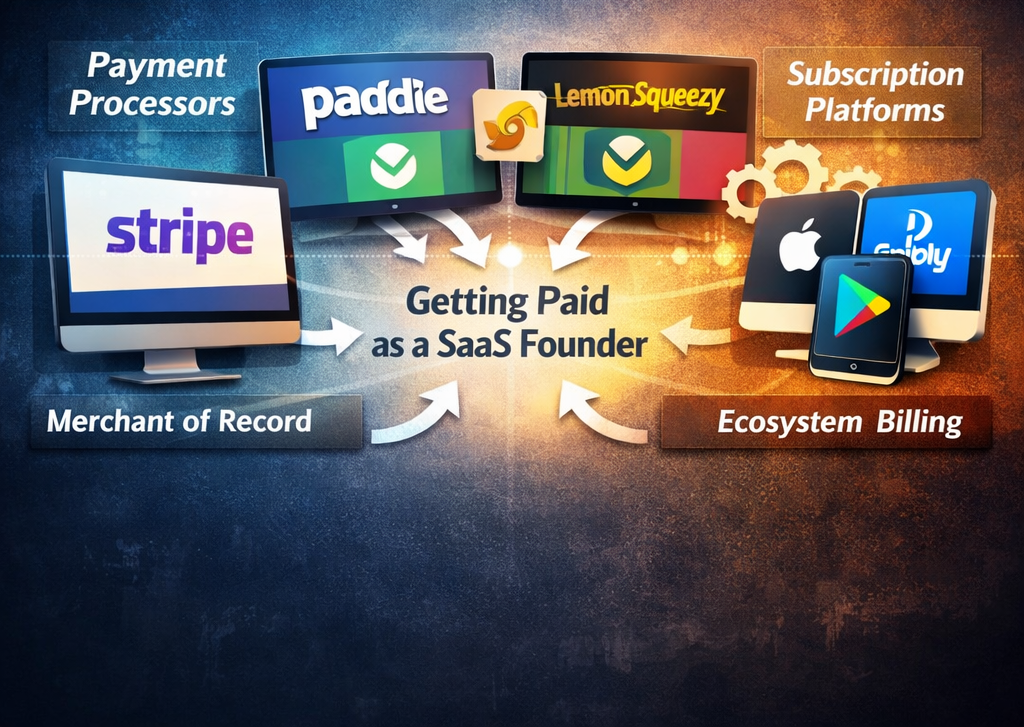
The Four Types of SaaS Payment Infrastructure
SaaS means software as a service, typically accessed online through a subscription. The categories below explain different ways of handling payments and related responsibilities, although they can overlap within a provider's product range.
Payment Processors (You Remain the Merchant of Record)
A processor helps you accept payments while your business remains the seller. You need to arrange the tax and billing work that applies to your sales, whether you handle it yourself or use additional services.
As checked on October 6, 2026, Stripe's US standard pricing lists 2.9% plus 30 cents for successful domestic-card transactions. That is a processing example, not a total cost estimate: other payment types, international cards, currency conversion, billing, and tax services can change the cost.
Merchant of Record Services (They Take On Defined Seller Responsibilities)
A merchant of record acts as the seller for covered transactions and takes on responsibilities defined by the service. This can include collecting and remitting transaction taxes. It doesn't mean every tax or legal obligation of your business disappears.
As checked on October 6, 2026, Paddle's pay-as-you-go pricing lists 5% plus 50 cents per Checkout transaction, including payment and billing services and tax compliance. Check the provider's product eligibility, supported markets, and agreement before deciding whether the service fits.
Subscription Infrastructure Layers
Subscription layers such as Chargebee and Recurly sit above a payment processor, adding capabilities for usage-based billing, complex invoices, or enterprise requirements. Their platform cost sits alongside processing fees, and the additional flexibility can require more implementation work. The fit depends on whether your billing needs justify that complexity.
Ecosystem Embedded Billing
An app store may provide billing as part of its distribution system. Apple's App Store and Google Play are examples. Fees and available billing arrangements depend on the program, product, and market, so compare the current terms that apply to your app. Distribution access comes with rules and limits on how you sell.
Compare the Actual Product, Not Just the Provider
Standard Stripe Payments and Stripe Tax
With standard Stripe payments, your business remains the merchant of record. Stripe Tax can support tax calculation, and its filing documentation describes automated US filing and filing-partner options. Registration and filing are separate services with their own coverage and setup. The older shorthand that “Stripe calculates, but you must always file manually” is no longer a useful comparison.
Merchant of Record Options
Stripe also offers Managed Payments, a separate merchant-of-record service for eligible digital products. It handles covered transaction taxes and other transaction responsibilities within its supported scope. It's a different arrangement from adding Stripe Tax to standard payments.
Paddle and other merchant-of-record providers are options to assess alongside that arrangement. Compare eligibility, checkout and billing requirements, customer support responsibilities, data access, and the work involved in moving later. A simpler tax workflow may be valuable, but the service still needs to fit how you sell.
Account for the work left with your business
There's no revenue level that automatically makes tax administration manageable. The work depends on what you sell, where the business and customers are located, the applicable rules, and the support available.
Map those questions with someone qualified to assess your obligations, then compare which registrations, returns, and payment responsibilities each service covers. Include its cost and what remains with your business, rather than assuming a particular revenue threshold or mostly domestic sales makes the work simple.
Compare the Total Cost
For a simplified illustration, 3 percent of $500,000 in annual processed sales is $15,000; 6 percent is $30,000. Those are hypothetical effective rates, not current quotes for two equivalent services. The difference alone doesn't tell you which arrangement costs less to operate.
Include transaction fees, billing and tax services, accounting support, implementation, refunds or disputes, and the staff time needed to maintain the arrangement. Your expected transaction sizes and customer locations make that comparison more useful than headline percentages alone.
Choose the responsibilities your business can realistically manage, then revisit the arrangement as sales and operating needs change.
Related Articles
Marketing Attribution, Fading Influence, and the Delay Before a Sale
How to assess earlier marketing work when the sale comes later
Read more →Where Is Value Actually Created in a Business?
Customers experience the entire chain of interactions — not just the product.
Read more →How Do I Get Leads Without Spending All Day on the Phone?
Build a Lead System That Works While You’re On the Job Site
Read more →