
Should You Build Your Website Yourself, or Hire Someone Like Me?
Understanding the constraints that should drive this decision
I run a business that builds websites and digital systems, so I have a commercial interest in this question. Even so, hiring a professional isn't always the right choice. The decision depends on your budget, time, and how clearly you understand what the site needs to do.
I want to examine the work and responsibilities behind that choice rather than offer a universal answer. Both building the site and hiring help involve costs that may only become clear later, so the decision needs to fit the business as it is now and leave room to reassess.
Start with what the website needs to do
Customers may use your website to check services, read about your work, or decide whether to contact you. What the site needs to do depends on how your customers actually find and choose the business.
That gives you a starting point for deciding who should build it and how much to invest. A site supporting a simple referral-based service may have different needs from one handling bookings or online sales.
The Real Cost of Building It Yourself
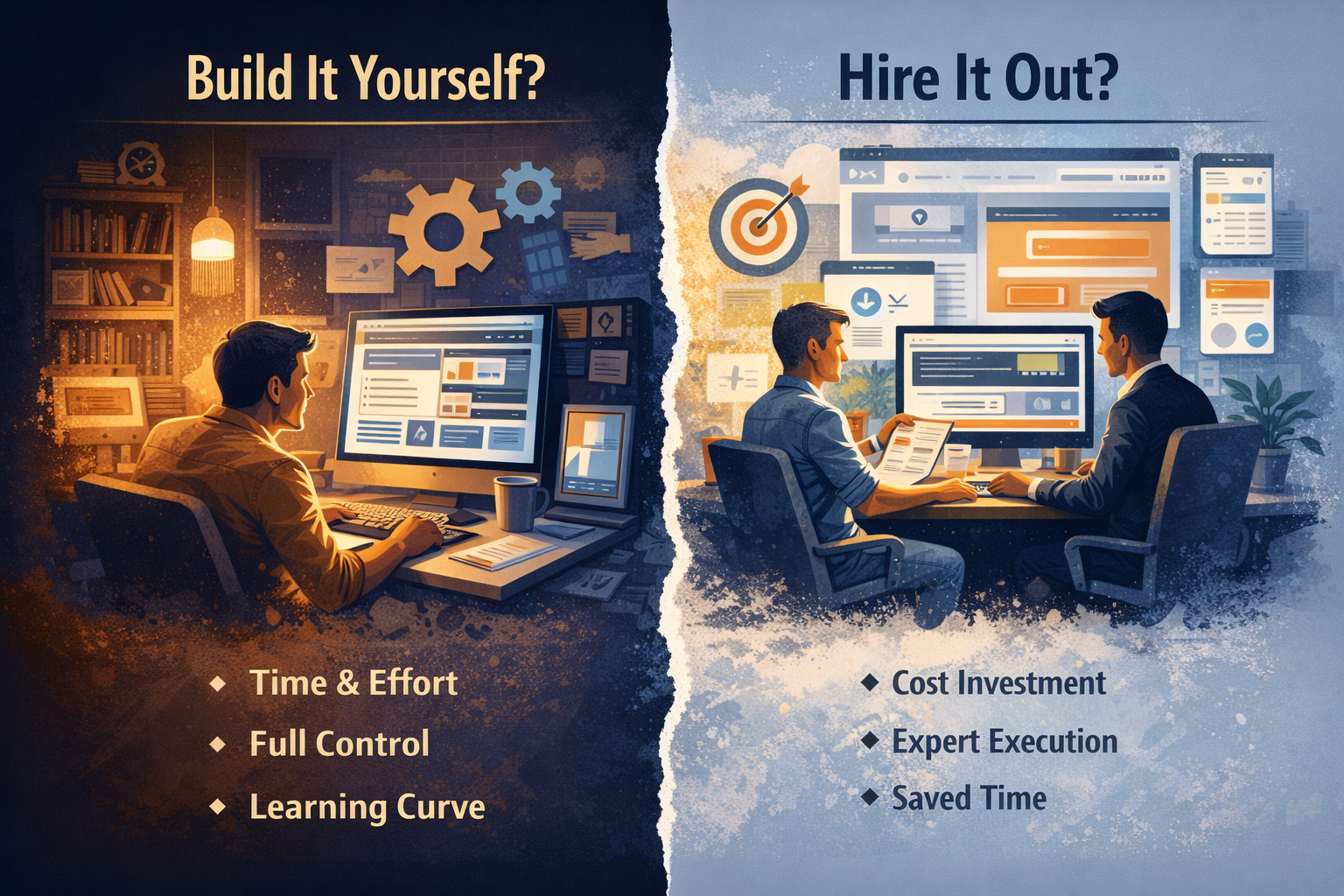
Building the site yourself uses time and attention alongside the money it may save. For an owner already working a full day, that can mean evenings or weekends spent on the site instead of customers, the offer, revenue, or rest.
Learning design tools, technical basics, and a platform's limitations is part of that investment. The important comparison is what that work displaces and whether the learning will remain useful.
There are real benefits to understanding how digital systems work, controlling updates, and working through the message yourself. Explaining the offer can reveal gaps you hadn't noticed while discussing it informally.
Those benefits need to be weighed against delays and work that doesn't serve the customer. From what I've seen, an owner might spend three months on details when a useful site could have been ready in three weeks with help, although that depends on the project and what was understood at the start.
Those outcomes aren't guaranteed. My experience with dozens of owners has made me treat them as possibilities worth examining rather than assume the less expensive initial option has the lower overall cost.
The Risk of Hiring Too Early
Hiring too early creates another kind of risk. If the offer changes week to week, positioning is unclear, revenue is unstable, or the owner doesn't yet know what the site should support, a finished design may get ahead of the business.
A designer or strategist can help you clarify the offer, but you still need to make decisions about what you're selling and learn whether customers want it. Commissioning a finished site before doing that work can create expensive revisions.
A simple site you can revise yourself may fit that stage better. Working through the message and audience can help you learn what matters before paying someone to turn it into a more finished experience.
Where the Bias Usually Creeps In
Agencies tend to emphasize time saved by hiring, while DIY advocates emphasize money saved by using accessible tools. Each argument describes a real benefit but leaves out the circumstances that determine how valuable it is.
I find it more useful to identify the constraint than defend either option in general.
A budget that can't absorb a few thousand dollars points toward different choices from a workload already at capacity. An offer that's still being tested raises a different question again, because neither a designer nor a builder can remove the need to learn what customers want.
The Problem With Hindsight
Some costs only become clear afterward: time spent on features nobody needed, a delayed launch, or work that has to be redone. You can't know all of that in advance. Choose a manageable first step and a point to reassess, whether you build the site yourself or hire someone.
Options Between Doing Everything Yourself and Hiring an Agency
You can also divide the work. An owner might build the site while getting strategic help, or pay a technically skilled friend with clear scope and boundaries for the parts they can't handle.
Another option is to hire for structure, strategy, or messaging and implement the plan yourself. A basic site can also cover the immediate need while leaving a later investment for a stage with more revenue and clearer requirements.
The arrangement can change as the business does. Choosing a manageable approach now doesn't require using it indefinitely.
Match the Website to Your Current Stage
Examine whether you're testing an offer, making the business more stable, supporting growth, protecting what already works, or removing a specific obstacle to further growth. Those stages ask different things of the website.
A simple DIY site can fit a period of rapid learning, while a more established operation may need a dependable booking or sales process that justifies help. Timing and capacity shape the decision as much as the tools available.
Where I Actually Stand on This
I build websites for a living, but I don't assume a larger website project is the answer. Building it yourself may help clarify the offer, targeted help may remove a specific obstacle, or the more useful work may be elsewhere in the business. I'd rather understand that need first.
Choose for the Constraint You Face Now
Choose for your current stage, capacity, and immediate problem, including whether the constraint is budget, time, or an unsettled offer. That gives the decision a purpose you can revisit.
Some costs will only become clear six months from now, whether you build or hire. Leave room to reassess as the business changes.
Related Articles
The Solo Operator - Part 1
Wearing Every Hat: The One-Person Business
Read more →Starting a Business When You Don’t Know Anyone
The entry points most new founders overlook when they think about starting locally.
Read more →Marketing Attribution, Fading Influence, and the Delay Before a Sale
How to assess earlier marketing work when the sale comes later
Read more →