
Starting a Business When You Don’t Know Anyone
The entry points most new founders overlook when they think about starting locally.
Starting a business without knowing anyone locally creates a problem that paperwork, a website, or branding won't solve on its own. You may have a useful product or service but little sense of how to reach people in an industry or neighborhood where the relationships already seem established.
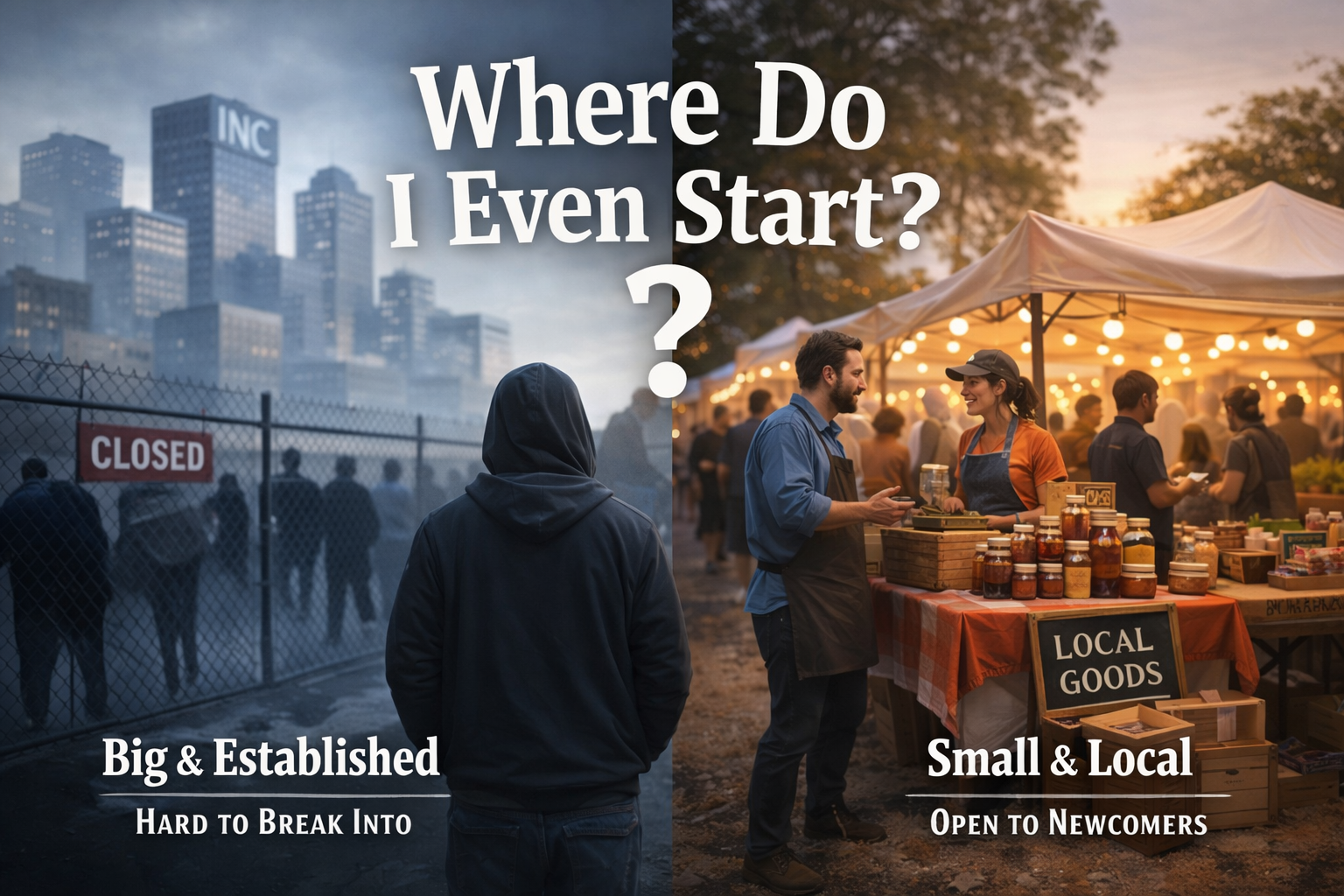
The physical world can feel less open than the internet, as though everyone knows each other and there's no obvious way in. Finding a place to begin often involves smaller interactions than that impression suggests.
Established Businesses Started Somewhere
The businesses that feel established today often began with something modest: a table at a market, a conversation with a store owner, or a service offered to a neighbor. Their current size doesn't tell us much about the first opening they found.
In everyday conversation, a small business often means a company whose owner is directly involved in the work and customer relationships. Restaurants, bakeries, salons, repair services, local retailers, contractors, and product makers are familiar parts of community commerce, even when larger companies get more attention.
The formal definition is broader with the U.S. Small Business Administration considering most companies with fewer than 500 employees to be small businesses, though the threshold varies by industry. And there's a middle category too, sometimes called mid-market, with dozens or hundreds of employees and regional reach. But a lot of those companies grew to that size after years of operating at a much smaller scale.
Larger companies typically expand through capital investment, logistics, and corporate planning, rather than the market tables and storefront conversations available to a new local business. That doesn't make those smaller entry points insignificant; many established companies grew from much more modest beginnings.
For someone getting started, looking at those beginnings can be more useful than comparing a new business with an organization that already has years of customers and relationships.
Finding Openings in Local Business Networks
Local business networks can feel closed from outside, but from what I've seen, vendors rotate, businesses close, owners change, and events look for participants. Those changes create openings that aren't always visible until someone asks.
An email, a vendor form, or a conversation with a store owner can help reveal one of those openings. Reaching out won't guarantee an opportunity, but it gives you a way to learn where one might exist.
Some Ways People Actually Enter the Physical Economy
Farmers markets seem to be one of the more natural places people start. They tend to be set up for small producers, small batches, and new vendors. Someone makes something: baked goods, handmade products, specialty foods, crafts. They apply to a market, set up a table, and find themselves having real conversations with real customers for the first time.
That single table can become a feedback loop pretty quickly. You start to notice what people ask about, what they pick up, what they buy, and what they walk past without stopping. For a lot of people, that's the first moment an idea starts to feel like something real.
Local retail stores can work this way too. Boutiques, gift shops, and specialty stores seem to work with local vendors more often than people might expect, sometimes buying inventory wholesale, sometimes selling on consignment, sometimes just curious about what's out there. The conversation usually starts the same way: someone walks in and mentions they make something locally and wanted to see if the store ever works with local vendors. From what I've heard, that's not an unusual thing for a store owner to hear.
Pop-ups and temporary markets can provide another way to test an idea. Holiday markets, maker markets, craft fairs, and street festivals put a product in front of people for a limited period, letting a new business learn from conversations and purchases before committing to a more permanent presence.
Service businesses may start without a booth or shelf. Posting in a community group, introducing yourself to nearby businesses, or leaving a card with a related service provider gives people a way to discover the work. From what I've seen, those early conversations can begin the trust a local service depends on.
The Physical Economy Runs on Conversations
An email, vendor application, or short conversation may not look like much at first, but it can introduce a new business to customers, another owner, or an event organizer. Each interaction gives you more information about where your offer fits.
You don't need to enter the entire local economy at once. Finding one place to participate and learn can make the network feel less closed while giving you a practical next step.
Related Articles
The Solo Operator - Part 1
Wearing Every Hat: The One-Person Business
Read more →Building Your Own Engine or Joining One?
What shifts when you move from operating inside a system to building your own
Read more →Should You Build Your Website Yourself, or Hire Someone Like Me?
Understanding the constraints that should drive this decision
Read more →