
The Math of Repeat Revenue
How small improvements in retention can help quietly reshape long-term revenue
Part 2 of 4 in Why Diners Don’t Come Back
- 1. The Second Visit Isn't Automatic
- 2. The Math of Repeat Revenue
- 3. What Actually Increases Repeat Visits
- 4. The Quiet Systems That Drive Loyalty
In the previous piece, I looked at the gap between first and second visits. A simplified revenue example helps explain why that gap deserves attention.
I've never owned a restaurant, but working in hospitality has shaped how I understand small businesses. I've carried sushi boats and plates through packed Saturday nights, sold the last cuts at a steakhouse, watched managers worry over light reservations, and seen the difference between a room of regulars and one full of first-time guests.
My parents also owned a business, so I spent plenty of time there working, watching, or doing homework. Those experiences taught me that a busy operation and healthy revenue aren't necessarily the same thing.
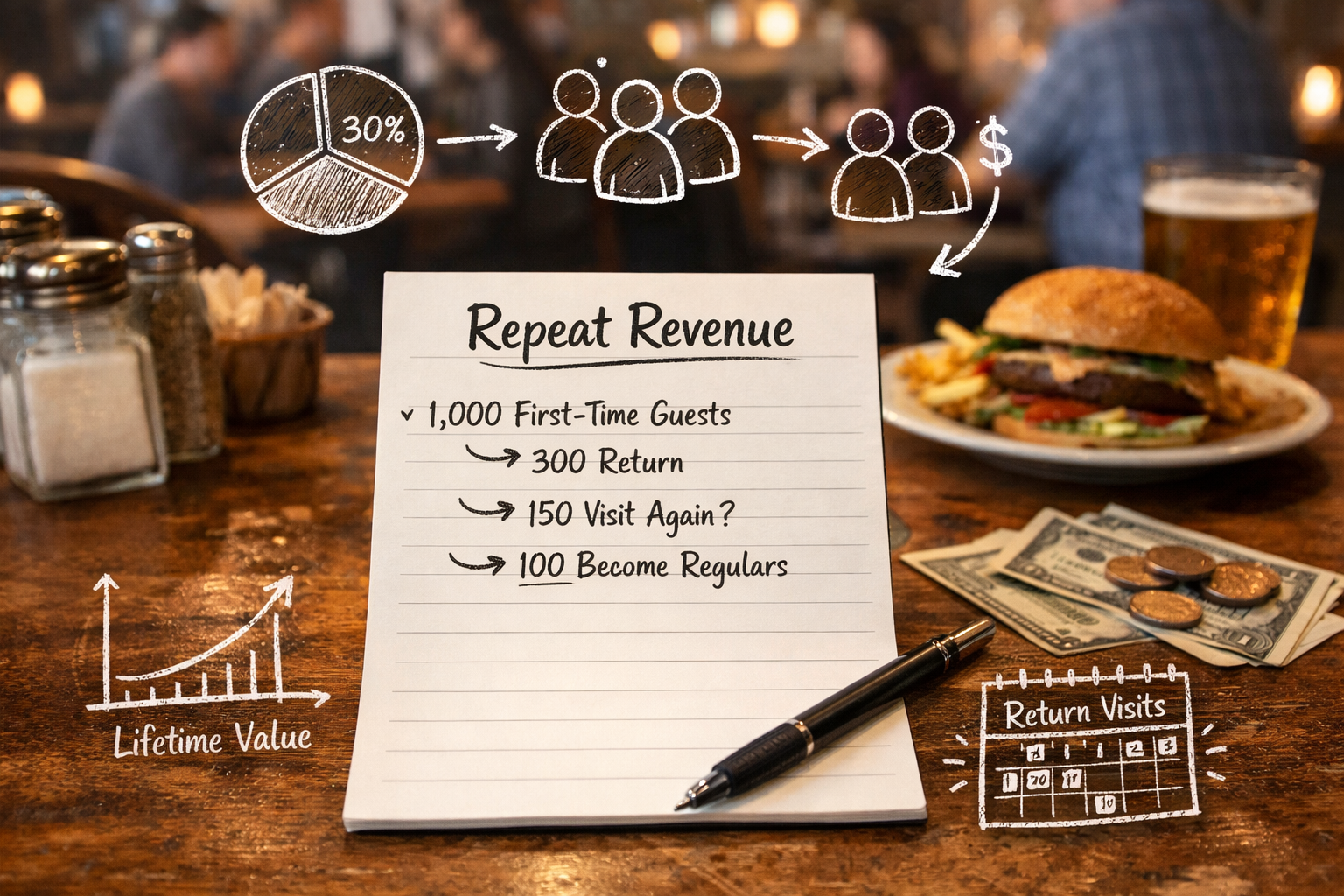
To explore that difference, assume that 30 percent of first-time guests return. The numbers below are hypothetical, not an industry benchmark.
What 1,000 First-Time Guests Actually Means
The example is simplified rather than a verified pattern for every restaurant or market.
Imagine 1,000 first-time guests visiting in a month. From the floor, that can look like momentum, but it doesn't establish how much of that activity will continue.
At a 30 percent return rate, 300 come back and 700 don't. Those 700 may have enjoyed the food, service, and space without choosing it again.
A different restaurant, a friend's preference, or convenience can influence the next visit even when nothing went wrong with the first.
Of the 300 returning guests, imagine 150 making a third visit and about 100 becoming regulars over time. That leaves around 100 of the original 1,000, or about 10 percent, contributing more consistently to future revenue.
Again, those figures describe the example, not a measured restaurant-wide pattern.
Where the Weight Really Sits
As a server, you recognize regulars' orders and preferences and see them every few weeks or on Friday nights. Their importance to the business comes partly from that steadier pattern rather than any difference in the value of the person.
A guest spending 40 dollars once produces one transaction, while a guest spending 40 dollars each month produces 480 dollars over a year. Continuing that pattern for a few years changes the relationship's revenue contribution.
That illustrates how a relatively small returning group can account for a larger share of long-term revenue.
The same distinction applies beyond restaurants: acquisition introduces a customer, while return business can make revenue less dependent on continually finding someone new.
A Small Shift That Adds Up
For the same 1,000 first-time guests, moving from a 30 percent return rate to 35 percent means 350 return instead of 300. That's 50 more people making another visit.
Some of those 50 may return again, which is why a change early in the relationship can have effects beyond the immediate month. The extent still depends on later behavior.
Looking only at tonight's covers or this week's sales can make that longer pattern harder to see.
Single Visit Margin Versus Long-Term Value
Table turns, check averages, and margins all matter, but they describe different parts of the business from how long a guest remains connected to it.
A returning guest produces another transaction without beginning the relationship from scratch. Examining that continuation gives you another way to consider revenue alongside the amount spent on one visit.
The question becomes how to support another useful experience, rather than focus only on extracting more from the current interaction.
Examine the pattern in your own business
Working inside and for small businesses has shown me how fragile revenue can feel when it depends entirely on new activity. The hypothetical example gives us a way to discuss that dependence, not a prediction of what every business will experience.
If 1,000 new guests arrive next month, consider how many remain connected six months later and what a small improvement might change. Your records, guest behavior, and cost of encouraging returns are needed to turn the illustration into a business decision.
The math helps distinguish a busy period from a steadier relationship with customers. It gives you something to investigate rather than a return rate to assume.
Related Articles
The Second Visit Isn't Automatic
Rethinking How Restaurants Earn Loyalty
Read more →What Actually Increases Repeat Visits
A practical look at the small systems that often influence repeat visits
Read more →The Quiet Systems That Drive Loyalty
Great experiences create satisfaction, but simple systems can help influence whether someone actually comes back.
Read more →