
What Actually Goes Into SEO (Beyond Keywords)
The technical pieces that help search engines understand, crawl, and index a website.
A useful website can't bring in customers through search if its pages can't be found or understood. Search engine optimization (SEO) includes the work of making that content accessible and clear, alongside choosing topics and language relevant to customers.
Keyword discussions tend to get the attention, but visibility also depends on the structure and technical behavior of the website. Content has a better chance of being discovered when those supporting pieces work together.
Search systems use page structure, metadata, and other signals to interpret content. Making those signals clear helps explain what a page is about beyond the impression its design gives a human visitor.
SEO as a Layered System
I think about that supporting work as layers rather than a single tactic. The diagram shows a simplified view of how they fit together:
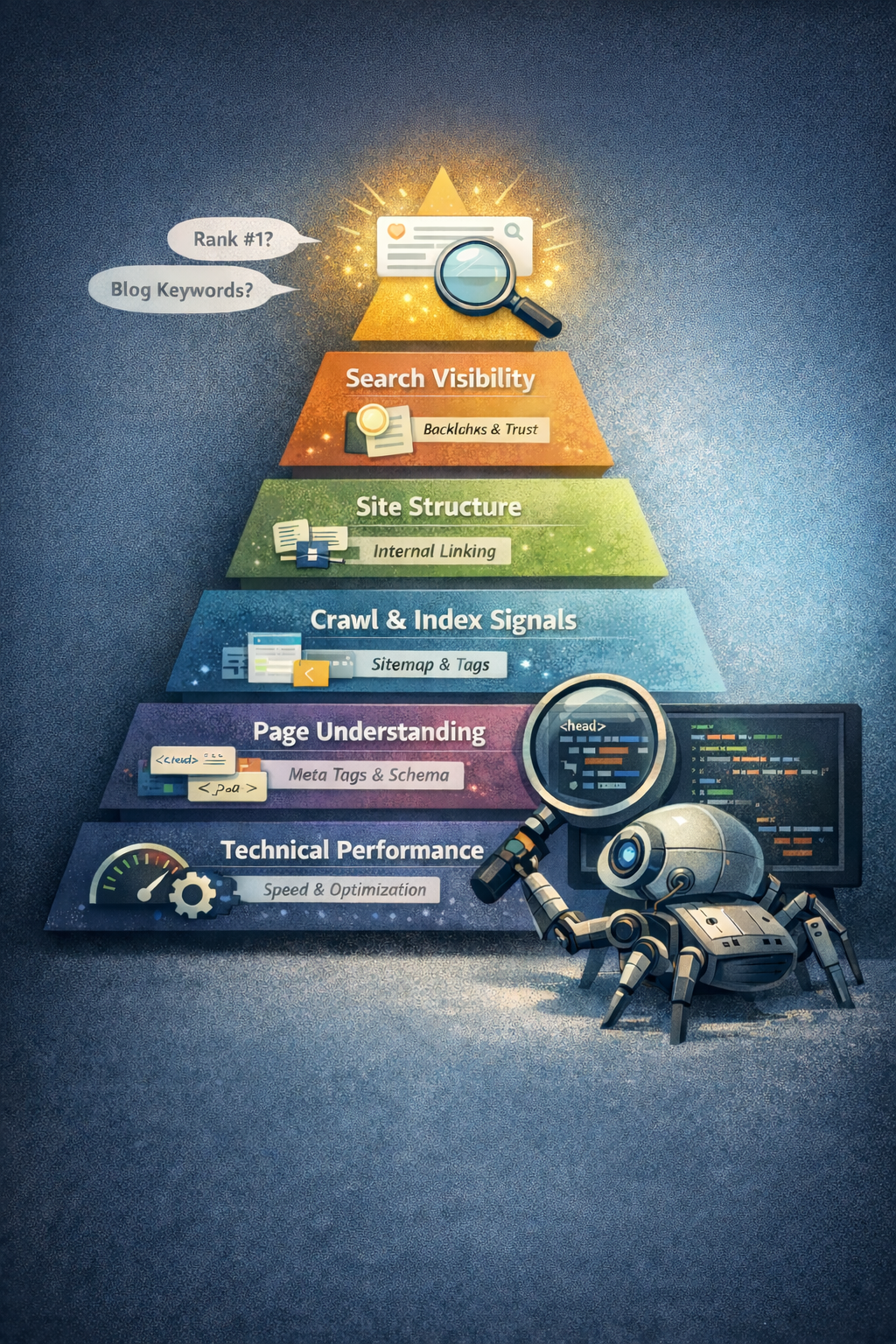
Content and keywords are part of the system, while the layers beneath them help search engines reach and interpret that content.
1. Making Pages Understandable
Before search engines can rank a page, they have to understand what it is. That's where metadata and structured signals come in.
Meta tags tell search engines the primary topic of the page and often appear directly in search results. Open Graph and Twitter metadata define how the page appears when shared on social platforms. Although designed for social platforms, they still provide additional context about the page.
Structured data adds explicit meaning to content. Instead of guessing what something represents, search engines can read structured markup that identifies elements like businesses, articles, products, or events.
Metadata gives context about the content rather than replacing it. A useful title or description still needs to match what the page actually explains.
Here's what that can look like:
<head>
  <title>Restaurant Marketing Systems | Your Company</title>

  <meta name="description"
        content="We help restaurants capture guest data, increase repeat visits, and grow revenue through smarter marketing systems." />

  <meta property="og:title" content="Restaurant Marketing Systems" />
  <meta property="og:description"
        content="Tools to capture guest data and turn first-time diners into repeat customers." />

  <meta property="og:type" content="website" />
  <meta property="og:url" content="https://example.com/restaurant-marketing" />

  <meta name="twitter:card" content="summary_large_image" />
</head>
JSON-LD is a format for adding structured data to a page. Here's an example:
<script type="application/ld+json">
{
  "@context": "https://schema.org",
  "@type": "Organization",
  "name": "Your Company",
  "url": "https://example.com",
  "logo": "https://example.com/logo.png",
  "sameAs": [
    "https://www.linkedin.com/company/example",
    "https://twitter.com/example"
  ]
}
</script>
The markup identifies the business, official social accounts, and relationships represented in the example. Structured data can also describe articles, products, events, FAQs, and reviews, with the appropriate type depending on the content.
2. Helping Search Engines Crawl the Site
Once a page is understandable, search engines still have to find it and navigate the site correctly. Three pieces typically handle this.
XML Sitemap
A sitemap lists pages you want search engines to discover. It gives crawlers URLs they can examine, including newer pages or ones deeper in the site.
<?xml version="1.0" encoding="UTF-8"?>
<urlset xmlns="http://www.sitemaps.org/schemas/sitemap/0.9">

  <url>
    <loc>https://example.com/</loc>
    <lastmod>2026-03-01</lastmod>
  </url>

  <url>
    <loc>https://example.com/blog/seo-foundations</loc>
    <lastmod>2026-03-02</lastmod>
  </url>

</urlset>
robots.txt
This file tells crawlers which parts of the site they're allowed to access and which areas should be ignored. It prevents search engines from spending crawl time on things like admin paths or duplicate environments.
User-agent: *
Disallow: /admin/
Disallow: /internal/

Sitemap: https://example.com/sitemap.xml
Canonical Tags
Sometimes the same content can exist under multiple URLs. Canonical tags tell search engines which version should be treated as the primary one.
<link rel="canonical" href="https://example.com/blog/seo-foundations" />
Without this, search engines might treat these as separate pages:
example.com/page
example.com/page?ref=twitter
example.com/page?campaign=spring
A canonical identifies the preferred version so search engines can consolidate signals associated with similar URLs.
These pieces give crawlers a more explicit way to find pages and understand which versions you intend to represent the content.
3. Structure Still Matters
Even with metadata in place, search engines still rely heavily on the structure of the page itself. This is where semantic HTML matters: using page elements that describe the role of the content they contain.
Heading hierarchy helps define the logical structure of the content. It signals which ideas are primary topics and which sections support them. Alt text describes images in a way that machines and accessibility tools can interpret. Semantic HTML elements like <article>, <section>, <nav>, and <header> help define the purpose of different areas of a page.
<article>

  <h1>What Actually Goes Into SEO</h1>

  <section>
    <h2>The Foundation</h2>
    <p>Search engines rely on metadata and structure...</p>
  </section>

  <section>
    <h2>Helping Search Engines Crawl</h2>
    <p>Sitemaps and robots files guide discovery...</p>
  </section>

</article>
That structure makes relationships between sections clearer for readers, accessibility tools, and systems interpreting the page.
4. Performance Is Part of SEO
Technical performance also affects how people experience a page, with speed and responsiveness contributing to search evaluation. Improving them serves the visitor as well as the site's search visibility.
Common improvements include lazy loading images so they only load when they enter the viewport, compressing images and minimizing scripts to keep pages lightweight, and optimizing how fonts load to prevent layout shifts and improve rendering speed.
Fast, stable pages reduce the frustration of waiting or trying to interact with content that moves during loading.
5. Keywords Still Matter, Just Not the Way People Think
Keywords help search engines connect queries to relevant pages. But modern search engines are far better at understanding topics and intent, not just exact phrases.
Rather than repeatedly inserting a phrase like "best restaurant marketing software," explain the product, who it helps, the problems it addresses, and how it works. Relevant language still belongs in the page, but it needs to serve a clear explanation rather than stand in for one.
6. What Technical SEO Won't Do on Its Own
Technical SEO creates the conditions for visibility, but it doesn't automatically produce rankings. Other factors still play a major role.
Links from other sites act as credibility signals. Search engines tend to favor pages that genuinely answer questions or explain topics clearly. Internal linking connects related pages and helps search engines understand the relationships between ideas on your site. And trust builds gradually as a site consistently publishes useful content and earns references from other sources.
Technical work supports discovery and interpretation; useful content and credibility still need attention.
Decide which layer needs attention
When a site's search performance disappoints, adding keywords or articles may not address the actual gap. Check whether its pages can be found, interpreted, and used, then examine the relevance and usefulness of the content itself.
The technical pieces work together to make the site clearer. None establishes that a page will rank, but each gives you a specific area to investigate rather than treating SEO as one opaque problem.
That foundation helps useful content reach readers and gives you a better basis for deciding what to improve next.
Related Articles
Local SEO Explained: How Small Businesses Get Found Online
Understand the fundamentals behind rankings, reviews, and why your competitors show up before you.
Read more →AI Search and Organic Traffic: What Small Businesses Should Examine
Understanding the behavioral shift and how to refine your digital strategy without starting over.
Read more →Should You Build Your Website Yourself, or Hire Someone Like Me?
Understanding the constraints that should drive this decision
Read more →