
Should Your Growth Strategy Change as Your Business Grows?
Aligning customer acquisition, retention, and referrals with your current stage of growth
Advice to get more leads or drive more traffic can miss what a business needs now. A new operation may struggle to be discovered, while an established one may need more return customers or an easier referral process.
Investing in the wrong part of that process can make growth costly without addressing the constraint. I find it useful to examine the customer journey before choosing another campaign.
Look beyond the initial purchase
One way to examine the journey uses six stages: awareness, consideration, conversion (becoming a customer), experience, retention (returning), and referral. The first three often receive attention, while the last three can reveal opportunities to improve an existing relationship.
Digital tools can support each stage, but the choice of tool should follow the part that needs attention.
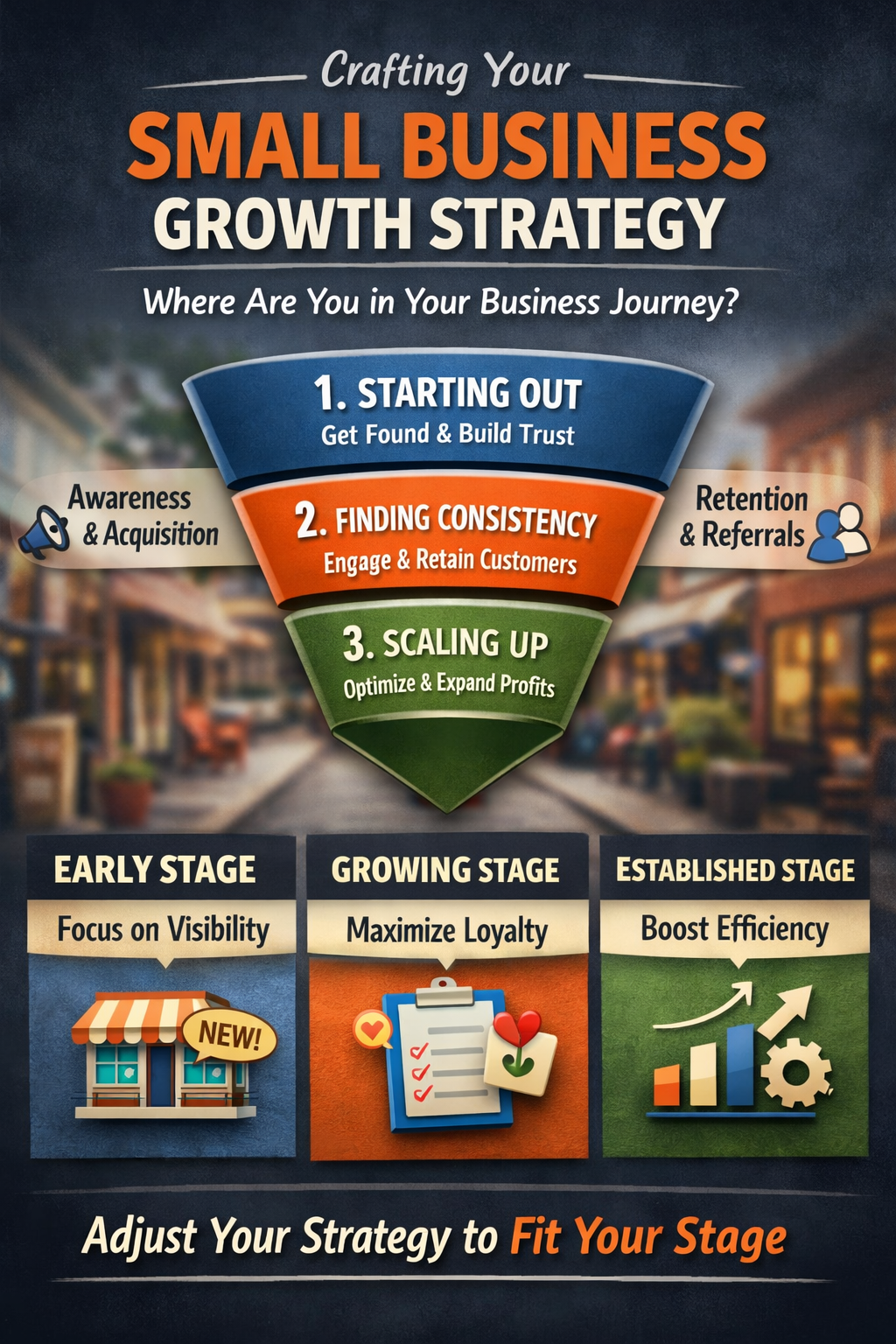
Stage 1: You're New and Building From Scratch
A new business may need to establish visibility and trust before it has enough customers to generate steady referrals. The immediate work is helping people find it, understand the offer, and make contact.
A clear mobile-friendly website, an accurate Google Business Profile, local search engine optimization (SEO), straightforward booking or contact, and honest early reviews can support that work.
A referral process may be useful too, but its value depends on having customers willing and able to recommend the business. Start with the gap that's preventing a first experience.
Stage 2: You Have Customers, But Growth Feels Inconsistent
Once customers are arriving, more advertising isn't necessarily the next answer. Inconsistent growth can also reflect weak follow-up or difficulty encouraging a return visit.
Consider review invitations, permission-based email capture, useful messages after a service, and a clear referral request. Each gives the business a repeatable way to continue the relationship without requiring a complicated setup.
A new customer can then become a source of repeat work, reviews, or referrals, although that result still depends on the experience and what the customer needs next.
Stage 3: You're Established and Want to Grow More Efficiently
With steadier demand, an established business may have more room to examine how to grow revenue efficiently rather than increase marketing spend.
Relevant follow-ups, loyalty programs, upgraded services, related products, and referral tracking are possible areas to assess. The purpose is to improve an existing customer process where it creates value, rather than assume additional traffic is always the main requirement.
How to Figure Out Where to Focus Right Now
Begin with the evidence: enough inquiries, their conversion into customers, return behavior, and referrals. Each describes a different part of the process.
Low visibility may call for better discovery. Plenty of customers with flat revenue gives you a reason to investigate retention, while satisfied customers who don't refer may face an unclear or inconvenient referral process. Those are hypotheses to examine, not automatic diagnoses.
Use what you learn to choose the next investment rather than follow a generic growth sequence.
Why Digital Systems Are Worth Setting Up Early
A manageable digital foundation can support the work before the need becomes urgent. A website can capture inquiries, organized records can make follow-up possible, and email, review invitations, and referral processes can reduce reliance on remembering every task manually.
Those systems still need ownership and a useful purpose. Introduce the pieces you can maintain and assess, instead of building the entire setup in advance.
Revisit the balance as the business changes
Discovery may dominate early on, while retention, referrals, and operating efficiency can become more relevant as the customer base develops. The balance depends on the business's actual constraint rather than its age alone.
Revisit that constraint as results change. A strategy that fits the current situation is more useful than one based on where another business is or where you hope yours will be.
Related Articles
Marketing Attribution, Fading Influence, and the Delay Before a Sale
How to assess earlier marketing work when the sale comes later
Read more →How Email Marketing Actually Works: The Ecosystem Behind Deliverability
A behind-the-scenes look at IP reputation, mailbox providers, and the infrastructure that determines inbox placement
Read more →Where Is Value Actually Created in a Business?
Customers experience the entire chain of interactions — not just the product.
Read more →